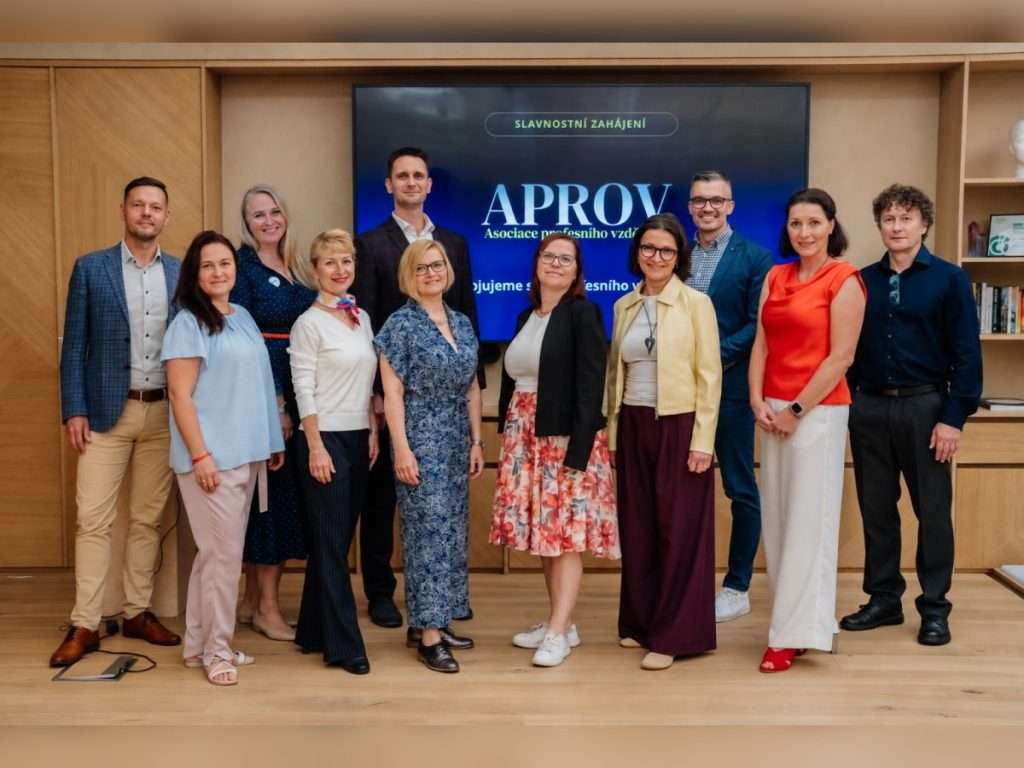
In spring 2026, the Professional Education Association (APROV) was founded, connecting companies and their HR and L&D teams, educational institutions, independent trainers, and academia. It's a four-sided relationship, albeit a somewhat uneven one. Threshold had the opportunity to be present at the association's founding and to become one of its members. Not so we'd have another logo on our website, but because it makes sense for us to discuss corporate education with people who look at it from different angles. Although, admittedly, the new logo does look rather nice on our website.
Language training has its own specifics
Language training differs significantly from some other areas of corporate education. For mandatory training required by law, it's usually fairly clear who needs to complete it, what it must cover, and how completion is documented. Soft skills training is often a shorter program focused on a specific skill or a change in workplace behaviour. But an ordinary mortal can't master a foreign language in a single workshop. It's a long-term process, and the result depends on the quality of teaching, regularity, the learner's motivation, contact with the language outside lessons, and whether the person actually has the chance to use their new skills in practice.
Language education does have fairly precise tools available, such as the Common European Framework of Reference, language exams, or external audits. However, the market for general language courses as a whole is not regulated. There's no generally mandatory trainer qualification, nor any universal state quality control for providers. That makes it all the more important for clients to know what questions to ask and what criteria to use when judging quality.
Experience from corporate language training can also be useful for other fields. We've long focused on setting measurable goals, placement testing, tracking participants' progress, and connecting course content with real work situations. At the same time, we can learn from fields that are further ahead in areas such as measuring the impact of training or working with short development programs.
Threshold on APROV's executive board
Representing Threshold in the association's work is Ladislav Blažek, who sits on APROV's executive board, where he represents the perspective of educational institutions. We don't expect him to defend only the interests of language schools. We'd like him to bring to the discussion the practical experience of a provider that designs and runs long-term training programs for companies. That includes not just the teaching itself, but also needs analysis, trainer selection and further development, setting training goals, administration, evaluating results, and regular communication with HR and L&D.
Educational institutions naturally compete with one another. But there are topics where greater openness benefits all of us: basic requirements for quality service, professional standards, the standing of trainers, and the way training is selected and evaluated.
What is APROV
APROV, the Professional Education Association, is a professional body focused on the development and quality of corporate and professional education in Czechia. It connects training buyers, HR and L&D professionals, educational institutions, trainers, academia, and other organisations that care about how people learn and develop in the workplace.
The association's goal is to support the professionalisation of the field, the sharing of experience, the creation of quality standards, and a stronger voice for professional education towards the state, employers, and the professional community. For us, membership in APROV is a natural extension of topics we've long worked on: the quality of teaching, measurable training outcomes, and responsible cooperation between client, educational provider, trainer, and course participant.
More information at www.aprov.cz.
First meeting showed appetite for shared discussion
On 9 September 2026, the first meeting of APROV members and other interested parties took place in Prague. Around one table — or rather, in one hall — representatives of companies, educational institutions, trainers, and people from academia all came together. It's precisely the diversity of their perspectives that we consider important. The point isn't for everyone to agree on everything immediately. What matters is that problems aren't discussed only within individual professional groups.
Over the coming autumn, expert groups within APROV are set to begin work, focusing on technology and artificial intelligence in education, financing, and the quality of educational services.
What we think APROV should deliver
We don't expect APROV to produce another certificate or add a new layer of administration. We'll consider it useful if it delivers concrete results: better guidance for clients, wider use of existing tools for assessing quality, the sharing of experience across fields, and a stronger voice for professional education in dealings with the state.
We'd like to see training programs chosen less often purely on the basis of lowest price, and more on what they're meant to change, how they're designed, and how their impact will be evaluated.
We're convinced that meaningful training doesn't start with a provider's offer. It starts much earlier: with a clearly defined need, well-set goals, and a properly prepared brief. We believe this is exactly where APROV can gradually make a difference.